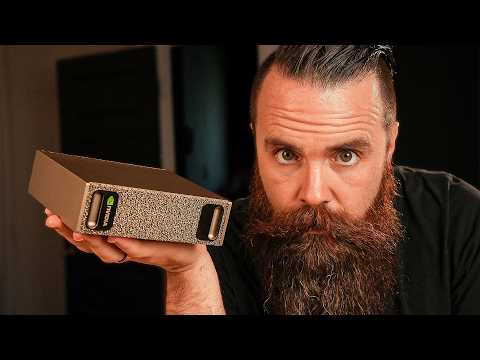
Nvidia's AI supercomputer, the DGX Spark, has been sent to review and test its capabilities. This device fits in the palm of your hand and runs AI models that even high-end systems like Terry can't handle. The Spark boasts impressive specs, including a GB10 Grace Blackwell superchip, 128 GB of unified memory, and a Blackwell GPU with one petaflop of AI compute. In this video, we dive into the device's performance, comparing it to other local AI hosting options and exploring its potential for developers and fine-tuning tasks. The Spark's unique features, including FP4 quantization and speculative decoding, make it an exciting option for those looking to run complex AI models locally.
Introduction
The video discusses the NVIDIA DGX Spark, an AI supercomputer that fits in the palm of one’s hand and can run complex AI models. The host received the device from Nvidia and is excited to test its capabilities.
Key Facts
- The DGX Spark has a 20-core ARM processor and a Blackwell GPU with 128 GB of unified memory.
- It can run up to 200 billion parameter models and costs around $4,000.
- The device has a unique feature called FP4 (Floating Point 4), which allows it to run AI models at high speeds while using less VRAM.
- The DGX Spark also supports speculative decoding, a technique that uses a smaller model to draft tokens ahead of time and then verifies them with a larger model.
- The device has a QSFP port for connecting multiple Sparks together for increased performance.
- The host compares the DGX Spark to his existing AI server, Terry, which costs over $5,000 and is much larger.
- The host notes that while the DGX Spark is not as fast as Terry in some tasks, it has several advantages, including its small size and ability to run multiple models simultaneously.
Conclusion
The host concludes that the NVIDIA DGX Spark is an impressive device with many capabilities, but may not be suitable for everyone, particularly those who require high inference speeds. He notes that the device is best suited for developers who need to fine-tune AI models on their desk and do not want to rent cloud GPUs. The host also mentions that he would like to see a future version of the device with higher inference speeds.